


Annual performance reviews fail because they are disconnected from daily execution. They measure a year of performance through the lens of the last 90 days, and they collapse a continuous accountability conversation into a single consequential event held once a year.
That is the structural problem the search for performance review alternatives keeps surfacing.
Companies replacing the annual review are not looking for a better format. They are looking for a performance infrastructure that holds execution consistent across the year. This article diagnoses why annual reviews fail structurally, identifies what a credible alternative has to deliver, and introduces the structural component that replaces the annual review inside an execution system.
Why Annual Performance Reviews Fail Structurally
Annual reviews fail structurally because they operate as documentation events rather than execution infrastructure. The review measures performance after the fact instead of supporting it in real time. It compresses a year’s worth of work into a single high-visibility conversation, and that conversation cannot influence the year it is reviewing. Managers and employees treat the review as a compliance event to complete, not as a structural mechanism that reinforces performance throughout the year. That is an infrastructure problem. A different review format will not solve it.
The Annual Review Arrives After Execution Has Already Happened
By the time the annual review conversation happens, the outcomes it is measuring have already had their full impact on the organization. Goals that were missed have stayed missed. Behaviors that drifted have already cost the team a quarter or two. Performance decline has already shown up in results the board has already read. The review cannot change any of that. It can document it. An organization that relies on the annual review as its primary performance infrastructure has no structural mechanism for surfacing execution problems while there is still time to correct course. Performance cadence has to operate continuously to be useful. Once a year is too late to be infrastructure.
Recency Bias Makes the Annual Review Structurally Unreliable
Despite how it gets framed, recency bias is a structural flaw of the annual review, not a flaw of the manager delivering it.
When twelve months of performance is reviewed in a single conversation, the most recent weeks disproportionately shape the assessment of the full year. That is the predictable result of an annual cadence applied to continuous human performance. The manager is not the variable. The cadence is.
The structural fix is to install a performance cadence that creates regular, documented touchpoints throughout the year, so performance is visible and discussed continuously rather than reconstructed annually.
Asking managers to remember the first nine months better will not change the math. A different cadence will.

What Performance Review Alternatives Need to Address
A structural replacement for the annual review has to meet four conditions.
Continuous performance visibility comes first. Execution has to be tracked in real time rather than reconstructed at year end, with goal data, progress signals, and roadblocks visible while the work is still in motion.
Next, the system needs regular, structured conversations that connect performance to organizational priorities consistently, not only at year-end.
A development mechanism has to operate alongside that cadence, surfacing growth opportunities as they emerge rather than accumulating them for an annual discussion.
And accountability has to hold consistently across the year rather than concentrating in a single event.
A model that delivers only one or two of these will produce activity without traction. The structural test for any alternative is whether all four conditions hold together inside a connected system.

The Performance Review Alternatives That Hold
Three structural models replace the annual review with infrastructure rather than format change.
Continuous feedback models build ongoing performance conversation into the operating rhythm of the team, replacing the annual event with regular cycles that surface signal in real time. The second category, quarterly performance structures, aligns the review cadence to how organizations already execute, anchoring feedback to goal cycles rather than to the calendar year. Going further still, goal-based performance systems anchor the conversation to visible execution data instead of manager recollection.
Each of these models has structural advantages over the annual review. The two that scale most reliably inside an execution system are the quarterly structure and the goal-based model, which the next two sections examine more closely.
Quarterly Cadence Outperforms Annual Cadence Structurally
Quarterly performance structures align with the natural execution rhythm of most organizations, which is what makes them hold where the annual cadence does not. Goal-setting, execution review, and planning horizons in most companies already operate on quarterly cycles.
When the performance conversation is anchored to the same cycle, feedback becomes connected to the work rather than disconnected from it. The manager and employee are not reconstructing a year. They are reviewing the quarter’s execution against the quarter’s commitments while the context is still fresh and the data is still actionable.
That structural alignment between performance cadence and execution cadence is the difference.
Annual reviews ask managers to assess work that ended months ago. Quarterly reviews ask them to assess work that is still in motion, against goals the employee is still committed to.
One conversation is about documentation. The other is direction.
Goal Visibility Changes What the Performance Conversation Is About
Goal-based performance systems shift the conversation from evaluation to execution review by anchoring it to visible, tracked goals rather than manager recollection.
The manager and employee look at the same execution data, including goal progress, roadblocks that were surfaced or missed, and the consistency of weekly progress signals. From there, the conversation is about what the data shows and what it means for the next cycle.
This is not a softer conversation than the annual review. It is a more precise one, because both participants are working from the same record. And precision produces more consistent accountability than subjective annual assessment.
When goal data carries the weight of the conversation, manager bias drops out as a primary variable, and the performance discussion stops depending on whose memory is sharper.

How P.A.C.E.™ Checkpoints Replace the Annual Review Inside an Execution System
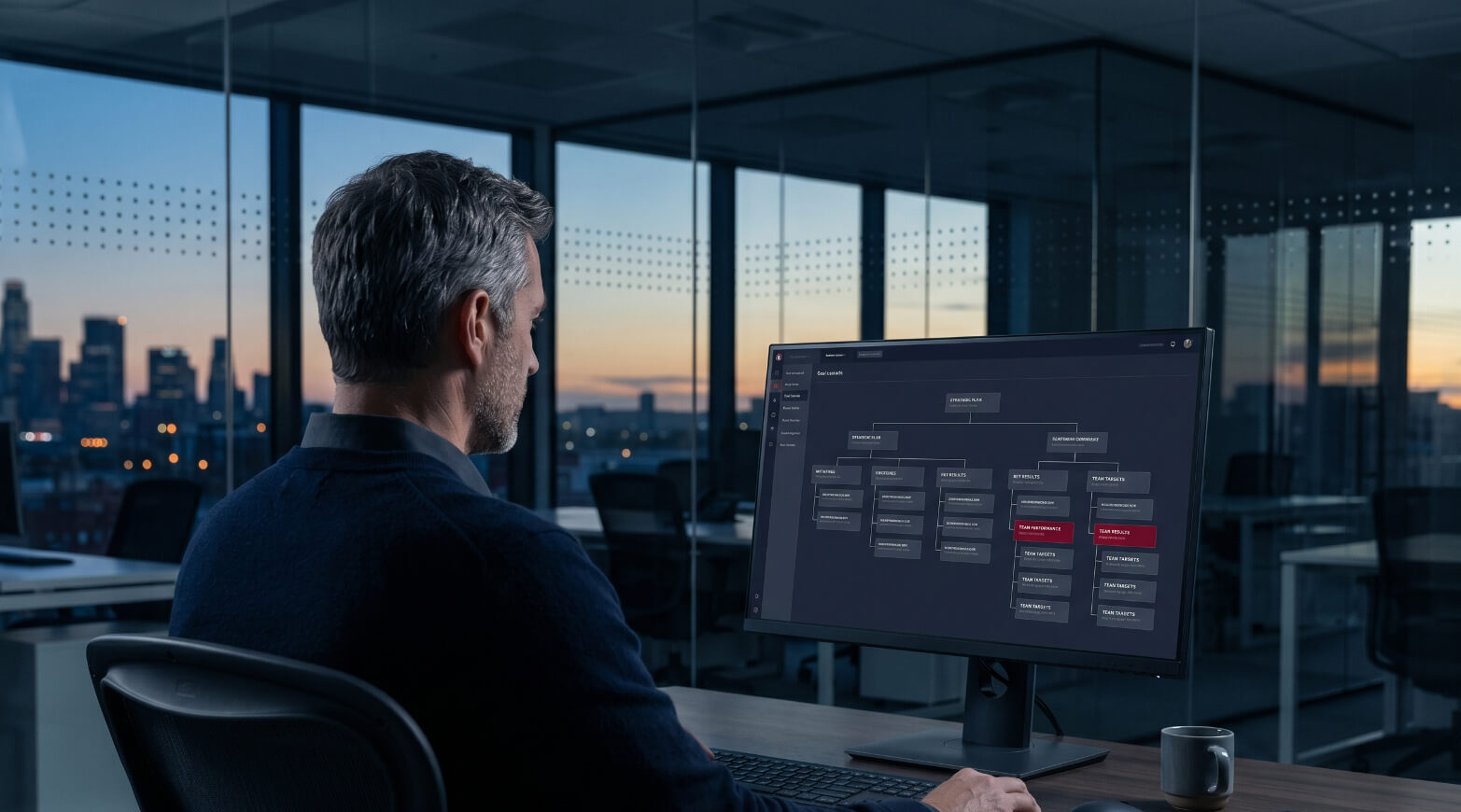
P.A.C.E.™ Checkpoints are the structural replacement for the annual review inside the Infrastructure Layer of the P.A.C.E.™ Operating System.
Each Checkpoint is the formal quarterly conversation that replaces the annual review, and its structure connects directly to the system that surrounds it. The conversation walks through how the employee lives the organization’s values, their goal performance against the quarter’s commitments, ratings against core competencies and key responsibilities, and closes by setting a performance or development goal for the next quarter.
None of this is reconstructed from memory. The Turnkey Goal System (TGS) carries the execution data into the conversation, so goal progress, weekly ratings, and surfaced roadblocks are already visible to both participants when the Checkpoint begins.
P.A.C.E.™ Checkpoints are not a rebranded annual review delivered four times instead of once. They are a structural component of an execution system where performance is visible, cadenced, and connected to the organization’s direction continuously through the year.
Learning Moments Fill the Space Between Checkpoints
Learning Moments operate between Checkpoints as the continuous development layer the formal review cannot provide on its own.
Each Learning Moment is a development discussion that can be positive or developmental, happens anytime in work and life, and does not require a formal meeting. A Checkpoint can drive a Learning Moments conversation when a development goal is set, but Learning Moments do not depend on a Checkpoint to happen.
What used to be the gap between annual reviews becomes filled, not with more formal meetings, but with a structural expectation that development conversations happen continuously, anchored to the execution cadence and triggered by the work itself.
Learning Moments are not a separate component. They are the development layer that runs continuously between Checkpoints, and goals that come out of them can be tracked inside TGS on quarterly timelines like any other goal.
The Problem Was Never the Review. It Was the Absence of an Execution System Around It.
Annual reviews do not fail because of their format or their frequency or the managers who deliver them. They fail because they are deployed as standalone events inside organizations that have no continuous execution infrastructure connecting strategy to daily performance.
The review by itself was never the lever. What surrounded it always was.
A functioning alternative is not a better review format. It is performance infrastructure that is cadenced, visible, goal-connected, and embedded inside an execution system, so that the review conversation becomes a natural point of accountability rather than a compliance event.
The right starting point becomes clear in the first conversation.

